





Short answer
A dehumidifier's pint rating is the amount of water it removes in 24 hours at 65°F and 60% relative humidity. That is a mild, humid condition — not a cold basement. Since the standard changed on 13 June 2019 from 80°F to 65°F, units rated before that date carry numbers roughly 1.7 to 2 times higher than an identical machine rated today.
The part most guides skip
The most useful comparison is not pints at all, but pints per watt. Two 50-pint units can differ by 40% in electricity use, which over three years outweighs a $40 price difference.
What the test actually does
The unit is placed in a sealed chamber held at 65°F and 60% relative humidity, run at maximum, and the water collected over 24 hours is weighed.
Every published pint rating on a US listing since mid-2019 comes from this procedure. It is a fair comparison between units, as long as all of them use the same standard.
The problem is not the test. The problem is that 65°F and 60% RH is a specific condition that your basement may not match.
The 2019 change and why listings still confuse people
Before 13 June 2019, the test ran at 80°F. Warmer air holds more moisture, so the same machine removed more water in the chamber and received a higher number.
This is why older buying guides, forum posts, and secondhand listings quote figures that look far better than current products. They are not lying; they are describing a different test.
When you see a capacity quoted without a test condition, treat it as unverified. A listing that does not state 65°F/60% RH is either old or is using a favourable condition to look better.
Marketplace listings frequently quote 'up to 4,500 sq ft' alongside a 50-pint rating. Those two figures come from different conditions and cannot both be true in a cold basement.
Cold basements: where the rating breaks down
A compressor dehumidifier works by condensing moisture on a cold coil. As ambient temperature falls, the coil gets less effective at pulling water out, and below roughly 60°F the decline becomes steep.
At 50°F, many compressor units extract a small fraction of their rated output. Some frost up and enter defrost cycles that pause dehumidification entirely.
If your space runs cold, the rating is close to meaningless. The relevant spec becomes the unit's minimum operating temperature, and desiccant units — which use a desiccant wheel instead of a cold coil — hold their capacity much better in the cold.
The number that actually predicts your bill
Pints per watt tells you how efficiently the unit converts electricity into removed water, and it varies far more between models than the pint rating does.
A 50-pint unit at 430 W is efficient. A 50-pint unit at 620 W is not, and over a wet season running 12 hours a day the difference is real money.
Calculate it once per model: divide pints by watts. Anything at or above 0.11 is good for a compressor unit. Below 0.09, you are paying for that inefficiency every month.
| Unit | Pints | Watts | Pints/W | 3-yr power cost* |
|---|---|---|---|---|
| Efficient 50-pint | 50 | 430 | 0.116 | ~$480 |
| Average 50-pint | 50 | 500 | 0.100 | ~$558 |
| Inefficient 50-pint | 50 | 620 | 0.081 | ~$692 |
*Assumes 12 hours/day at 55% duty cycle and $0.17/kWh. A $200 price gap between the efficient and inefficient units is wiped out in under two years by the electricity difference alone.
The same trick, in every other category
Pint ratings are the clearest example of a spec that is technically true and practically misleading, but they are not unusual. The pattern repeats wherever a manufacturer gets to choose the test conditions.
Power banks: the mAh figure is cell capacity at 3.7 V, while the port delivers 5 V or more. Conversion loss means a 20,000 mAh bank gives you roughly 12,000 mAh at the plug.
Portable heaters: rated wattage is a maximum, not a constant. A 1,500 W heater on a thermostat runs at that draw perhaps a third of the time, so the real hourly cost is well under the rated figure.
Air purifiers: CADR is measured at the highest fan speed. At the speed you can tolerate while sleeping, you are moving around half the air the label promises.
In every case, the question is not what the number is — it is what conditions produced it.
A spec sheet is a legal document, not a measurement of your room. It states the best case the manufacturer can defend. Your job is to work out how far your situation is from that best case.
Units that meet this spec
Each pick states the situation where it is the wrong buy. Nothing here is recommended for every room, and the cheapest option is included where it is genuinely the right one.
 1
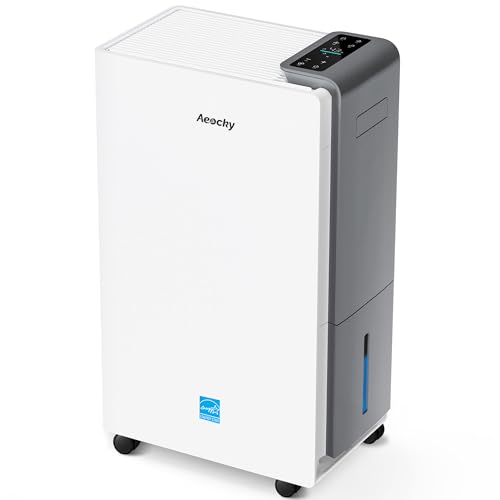
Dehumidifier with Pump Up to 16.5ft Energy Star Most Efficient 2025 AEOCKY
AEOCKY Dehumidifier with Pump Up to 16.5ft Energy Star Most Efficient 2025 — rated 4.5/5 from 7619 reviews, currently 5% off. 20% commission via PartnerBoost.
Rated 4.5 from 7619 buyers
5% off list price
Specs come from the listing title and may omit detail
Capacity figures are manufacturer claims, not independently verified
Skip it if: Check the sizing arithmetic on this page against your own room before buying. Listed capacity claims are manufacturer figures taken at favourable test conditions.
Prices and availability are accurate as of the date and time shown and are subject to change. Any price and availability information displayed on the retailer's site at the time of purchase will apply to the purchase of this product.
 2
5500 Sq.Ft Energy Star Most Efficient 2025 Dehumidifier for Basement AEOCKY
AEOCKY 5500 Sq.Ft Energy Star Most Efficient 2025 Dehumidifier for Basement — rated 4.5/5 from 7619 reviews, currently 7% off. 20% commission via PartnerBoost.
Rated 4.5 from 7619 buyers
7% off list price
Specs come from the listing title and may omit detail
Capacity figures are manufacturer claims, not independently verified
Skip it if: Check the sizing arithmetic on this page against your own room before buying. Listed capacity claims are manufacturer figures taken at favourable test conditions.
Prices and availability are accurate as of the date and time shown and are subject to change. Any price and availability information displayed on the retailer's site at the time of purchase will apply to the purchase of this product.
How these numbers were derived
We do not claim hands-on testing. Every figure here traces to a published standard or a documented calculation: the DOE test conditions in force since June 2019 for dehumidifier capacity, and the air-changes-per-hour convention for purifier coverage. Where industry practice and manufacturer claims diverge, we show both numbers rather than picking the flattering one.
If you find an error in the arithmetic, it is shown above so you can point at the exact step. We would rather be corrected than be confidently wrong.
Frequently asked questions
Why was the dehumidifier test standard changed in 2019?
The US Department of Energy moved the test temperature from 80°F to 65°F to better reflect how dehumidifiers are actually used. Most units run in basements, which are cooler than 80°F, so the old standard overstated real-world performance.
Is a 50-pint dehumidifier from 2018 the same as a 50-pint one today?
No. The older unit was rated at 80°F, so its 50 pints represents less real-world capability than a 2019-or-later unit rated at 65°F. Roughly, an old 50-pint unit performs like a modern 28 to 30-pint unit.
What is a good pints-per-watt figure?
Around 0.10 to 0.13 pints per watt at the rated condition is competitive for a compressor unit. Divide the pint rating by the wattage to check — a 50-pint unit drawing 430 W gives 0.116, which is good.