





Short answer
Divide the price by usable watt-hours — nominal capacity × 0.9 depth of discharge × 0.85 inverter efficiency — and the 20 power stations we track range from $0.37 to $3.11 per usable Wh. That is an 8.5x spread for electricity that behaves identically once it leaves the socket. The cheapest tier is almost always the largest unit from a mid-tier brand; the most expensive is almost always a small premium unit bought for pocketability, which is a different product category wearing the same label.
Models mentioned above
The part most guides skip
List price tells you nothing because capacity is not linear in price. A 1024Wh unit and a 2048Wh unit from the same brand cost roughly $530 and $950 — double the energy for 1.8x the money. But the moment you drop to 288Wh, the ratio inverts: $330 for an eighth of the capacity. Small units are not 'cheaper power stations', they are a portability product with a capacity tax.
The formula, and why both losses are real
The formula is short: usable Wh = nominal Wh × depth of discharge × inverter efficiency. For LiFePO4 packs, 90% depth of discharge is the standard safe figure. For inverter efficiency, 85% is a fair average across the units we track — the best reach 90%, the worst sit near 80%.
Neither loss is a manufacturer trick. Deep-discharging a lithium pack shortens its cycle life, so the BMS stops you before you get there. And converting 12V or 48V DC into 120V AC is a physical process with resistive and switching losses that turn into heat.
What varies is how honestly each brand reports it. Some publish usable capacity directly; most print only the nominal number, which is the larger one.
This page uses 90% DoD and 85% efficiency for every model, so the comparison is like-for-like. If a specific model publishes its own figures, its product page uses those instead.
Twenty listings, ranked by what the energy actually costs
Every model below is a real listing we track, divided by its usable capacity. Lower is better. Read the far right column as 'what one usable watt-hour costs me'.
Note the cluster: the cheapest six are all 2,900Wh or more, and four of the six are the same brand. That is not a coincidence — one manufacturer is pricing aggressively on large packs to win the backup-power buyer, and it shows.
| Model | Rated | Usable | Price | $/usable Wh |
|---|---|---|---|---|
| AFERIY 3840Wh | 3,840 | 2,938 | $1,079 | $0.37 |
| AFERIY P310 11520Wh | 11,520 | 8,813 | $3,327 | $0.38 |
| AFERIY P280 4096Wh | 4,096 | 3,133 | $1,349 | $0.43 |
| AFERIY 3840Wh (2nd) | 3,840 | 2,938 | $1,329 | $0.45 |
| BLUETTI B500K 5120Wh | 5,120 | 3,917 | $2,000 | $0.51 |
| Anker SOLIX C2000 | 2,048 | 1,567 | $950 | $0.61 |
| EcoFlow TITAN Classic | 10,017 | 7,663 | $4,699 | $0.61 |
| Anker SOLIX C1000 | 1,024 | 783 | $530 | $0.68 |
| EcoFlow TITAN Plus 15kWh | 15,000 | 11,475 | $8,799 | $0.77 |
| BLUETTI Elite 300 (panel) | 3,014 | 2,306 | $1,799 | $0.78 |
| EcoFlow TITAN Plus 10kWh | 10,000 | 7,650 | $6,169 | $0.81 |
| BLUETTI Elite 300 (350W) | 3,014 | 2,306 | $2,049 | $0.89 |
| EcoFlow TITAN 10kWh | 10,000 | 7,650 | $6,799 | $0.89 |
| EcoFlow TITAN 5017Wh | 5,017 | 3,838 | $4,199 | $1.09 |
| BLUETTI FridgePower | 2,016 | 1,542 | $1,799 | $1.17 |
| BLUETTI FridgePower (2nd) | 2,016 | 1,542 | $1,899 | $1.23 |
| Anker SOLIX C300 | 288 | 220 | $330 | $1.50 |
| Anker Prime power bank | 97 | 74 | $230 | $3.11 |
The two ends are not the same product
The two ends of that table are not competing for the same buyer:
- The $0.37/Wh end is an 8,813Wh pack that you will not carry up stairs alone.
- The $3.11/Wh end is a 74Wh bank that fits in a jacket pocket and charges a phone twice.
Judging the pocket unit by the large unit's $/Wh is the most common mistake in this category. You are not buying electricity — you are buying electricity *at a specific size and weight*.
So the right question is: what is the smallest usable capacity that covers my actual outage, and what is the best $/Wh at that size?
| If you need | Look at | $/usable Wh | Why |
|---|---|---|---|
| Under 1 kWh | 1,024Wh class | $0.68 | Small enough to move, still runs a fridge overnight |
| 1–3 kWh | 2,048Wh class | $0.61 | The sweet spot: covers most single-appliance outages |
| 3–5 kWh | 3,840Wh class | $0.37 | Cheapest energy in the whole catalogue |
| Over 10 kWh | Home systems | $0.38–0.81 | Read the inverter spec first, not the capacity |
Pick the band from your real load, then take the cheapest $/Wh inside it. Doing it in the other order — chasing the global minimum $/Wh — is how people end up owning 45 kg of battery to charge a CPAP machine.
What the price does not include
Two identical $/Wh figures can hide very different ownership costs. Output wattage decides whether the unit can run your load at all; capacity is irrelevant if the inverter trips first.
Solar input decides how fast you can refill without mains power. A 500W input sounds generous until you account for the fact that a portable panel delivers 50–65% of its rating on a good day, and much less in winter.
And cycle life decides how many years you get before the capacity above has halved. A unit that costs 20% more per Wh but lasts twice as long is the cheaper unit — the $/Wh column just does not say so.
Never buy on $/Wh alone at the very top of a brand's range. The largest units put their cost into the inverter and the home-wiring interface, not the cells — so their $/Wh can look fine while the actual job (running a house for three days) is being done by a licensed electrician you still have to pay.
Units that meet this spec
Each pick states the situation where it is the wrong buy. Nothing here is recommended for every room, and the cheapest option is included where it is genuinely the right one.
 1
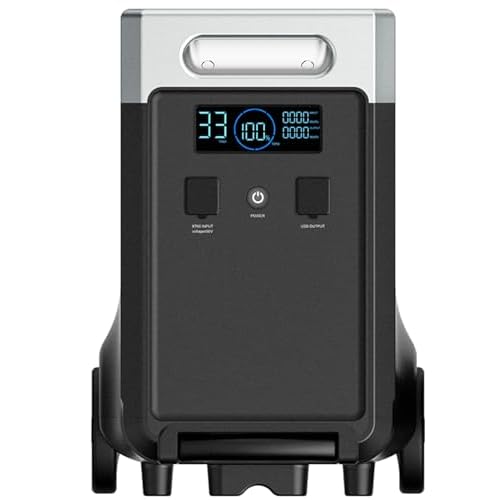
P310 Expansion Battery Pack, Add 3840Wh LiFePO4 Extra Capacity AFERIY
AFERIY P310 Expansion Battery Pack — rated 4.4/5 from 234 reviews, currently 10% off. 5% commission via PartnerBoost.
Rated 4.4 from 234 buyers
10% off list price
Specs come from the listing title and may omit detail
Capacity figures are manufacturer claims, not independently verified
Skip it if: Check the sizing arithmetic on this page against your own room before buying. Listed capacity claims are manufacturer figures taken at favourable test conditions.
Prices and availability are accurate as of the date and time shown and are subject to change. Any price and availability information displayed on the retailer's site at the time of purchase will apply to the purchase of this product.
 2
SOLIX C2000 Gen 2 Solar Powered Generator 2,048Wh, 2,400W, Camping Anker
Anker SOLIX C2000 Gen 2 Solar Powered Generator 2 — rated 4.7/5 from 768 reviews, currently 36% off. 3% commission via PartnerBoost.
Rated 4.7 from 768 buyers
36% off list price
Specs come from the listing title and may omit detail
Capacity figures are manufacturer claims, not independently verified
Skip it if: Check the sizing arithmetic on this page against your own room before buying. Listed capacity claims are manufacturer figures taken at favourable test conditions.
Prices and availability are accurate as of the date and time shown and are subject to change. Any price and availability information displayed on the retailer's site at the time of purchase will apply to the purchase of this product.
 3
SOLIX C1000 Gen 2 Solar Powered Generator Anker
Anker SOLIX C1000 Gen 2 Solar Powered Generator — rated 4.6/5 from 1803 reviews, currently 33% off. 3% commission via PartnerBoost.
Rated 4.6 from 1803 buyers
33% off list price
Specs come from the listing title and may omit detail
Capacity figures are manufacturer claims, not independently verified
Skip it if: Check the sizing arithmetic on this page against your own room before buying. Listed capacity claims are manufacturer figures taken at favourable test conditions.
Prices and availability are accurate as of the date and time shown and are subject to change. Any price and availability information displayed on the retailer's site at the time of purchase will apply to the purchase of this product.

FridgePower Power Station, 2016Wh Expandable 4032Wh LFP Battery BLUETTI
BLUETTI FridgePower Power Station — rated 4.4/5 from 426 reviews, currently 28% off. 10% commission via PartnerBoost.
Rated 4.4 from 426 buyers
28% off list price
Specs come from the listing title and may omit detail
Capacity figures are manufacturer claims, not independently verified
Skip it if: Check the sizing arithmetic on this page against your own room before buying. Listed capacity claims are manufacturer figures taken at favourable test conditions.
Prices and availability are accurate as of the date and time shown and are subject to change. Any price and availability information displayed on the retailer's site at the time of purchase will apply to the purchase of this product.
How these numbers were derived
We do not claim hands-on testing. Every figure here traces to a published standard or a documented calculation: the DOE test conditions in force since June 2019 for dehumidifier capacity, and the air-changes-per-hour convention for purifier coverage. Where industry practice and manufacturer claims diverge, we show both numbers rather than picking the flattering one.
If you find an error in the arithmetic, it is shown above so you can point at the exact step. We would rather be corrected than be confidently wrong.
Frequently asked questions
Why use usable Wh instead of the rated capacity?
Because the rated figure never reaches your devices. Every lithium pack holds back roughly 10% to avoid deep discharge, and the inverter loses about 15% converting DC to AC. A 2,048Wh pack delivers around 1,567Wh. Comparing rated numbers across brands is fine only if every brand uses the same depth of discharge and efficiency, and they do not.
Is the cheapest price per Wh always the best buy?
No. The lowest $/Wh units are the largest, which means 30–45 kg and no realistic way to move them. If your actual need is 'run the fridge for one night', paying $0.37/Wh for 8,813 usable Wh means buying roughly six times the energy you will use. The right metric is $/Wh at the capacity you need, not the global minimum.
Do expansion batteries change the calculation?
They improve it. An expansion pack carries no inverter, no AC outlets and no display, so per Wh it is cheaper than the main unit it attaches to. If you already own the base station, adding capacity via expansion is usually the best $/Wh available to you — but only if the base unit's inverter can actually deliver the load you want.
How often should I recompute this?
Every time you are about to buy. Power station pricing moves 20–30% around sales events, and the ranking inverts between them. The formula does not change; the inputs do.